
Which Processes Consume the Most Energy in a Leather Bag Factory?
Which Processes Consume the Most Energy in a Leather Bag Factory?
Ask a factory manager where the electricity goes and the answer is usually a guess: the machines, probably, or the air conditioning in summer. Ask again in a way that requires a number, and the guess often turns out to be wrong by a wide margin.
In the plants we have walked through, the ranking of energy consumers rarely matches the ranking of machines by how impressive they look. A room full of sewing machines can draw less than a single compressor that nobody thinks about, and an idle cutting press can sit at the top of the bill while running for two hours a day.
This matters commercially. Energy is one of the few production inputs that a bag brand can discuss with a factory using a shared, verifiable number, and it is increasingly asked about in supplier questionnaires, costing reviews and sustainability sections of tenders. Yet most of the discussion stays at the level of adjectives, because neither side has measured anything.
This guide is about measurement and where the kilowatt-hours actually sit in a leather bag factory. It covers how to read a meter rather than an invoice, which processes dominate, how to express energy per bag in a way that can be compared, and what a brand should ask for. It does not cover tannery water use, cutting waste, or general sustainability strategy, which are separate subjects with their own mechanics.
- Why the Energy Map Is Not the Electricity Bill
- Reading Meters Before Reading Invoices
- Where the Kilowatt-Hours Actually Go
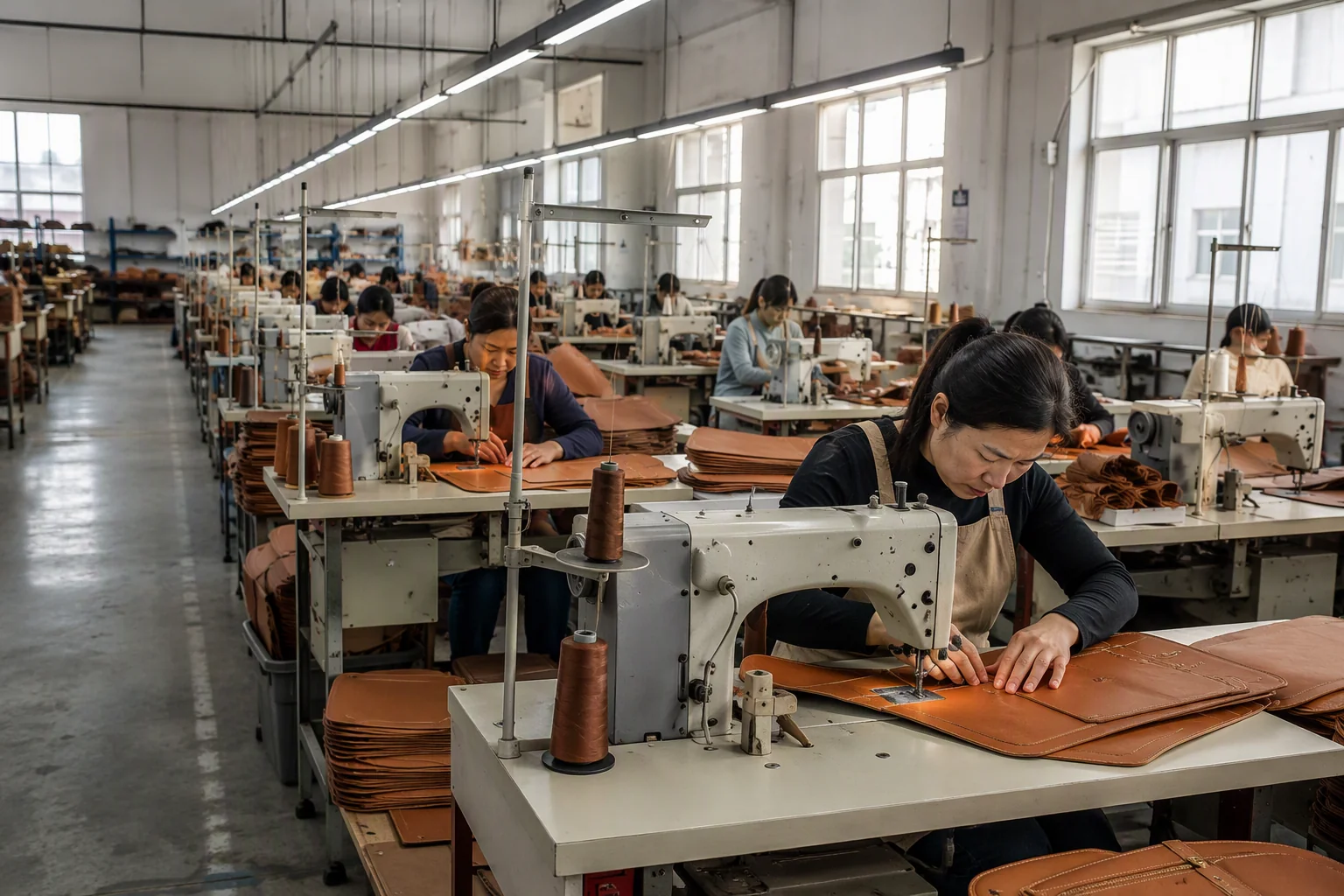
- Sewing Rooms: Many Small Loads
- Cutting and Skiving: Few Machines, Big Draw
- Compressed Air: The Most Expensive Utility per Unit
- Comfort Loads and Leather’s Own Requirements
- Energy per Bag: The Only Comparable Number
- Peak Demand and How Tariffs Punish Starts
- The Cheap Wins, in Order
- The Expensive Wins and When They Pay
- What a Brand Should Ask a Factory
- Claims, Contracts and Honest Language
- Common Measurement Mistakes
- A One-Page Energy Baseline
- Seasonal Peaks and How Leather Plants Cope
- People, Behaviour and the Limits of Technology
- Working With the Utility and the Landlord
- How Energy Shows Up in Price and Lead Time
- Frequently Asked Questions
- Conclusion
Why the Energy Map Is Not the Electricity Bill
The Bill Answers a Different Question
A monthly electricity bill tells you how much was consumed and what it cost. It does not tell you which process consumed it, which shift, or which machine. Those are the questions that lead to action, and they need a different instrument. Treating the bill as a map is the first mistake, and it is the reason so many energy reviews end with a vague commitment to “use less”.
Three Ways Energy Enters a Factory
Almost every load in a bag plant arrives as one of three things: electricity for motors, lighting and electronics; electricity for cooling and ventilation; and fuel or electricity for heat. Motors dominate in number, cooling dominates in hot months, and heat processes dominate in plants that fuse, emboss or cure. Knowing which of the three is largest in a particular plant is the first useful fact.
Why Leather Plants Differ From Other Workshops
Leather brings its own requirements. It is heavy, so transport and lifting equipment work harder. It is hygroscopic, so humidity control matters more than in a textile plant. It marks easily, so lighting is often brighter than strictly necessary for the task. And it is expensive, so plants hold stock that needs conditioned space. Each of these shifts the energy profile away from a generic assembly workshop.
Reading Meters Before Reading Invoices
Sub-Metering Without a Consultant
You do not need a consultancy to start. A clamp-on logger placed on the main feed for a week gives a load profile. Portable plug-in meters on a sample of machines give duty cycles. A few hours with a handheld meter and a notebook, repeated across shifts, produces a picture accurate enough to rank consumers, which is all the first pass needs.
Load Profiles and Shift Patterns
Consumption during production hours is expected. What matters is the gap between production hours and the rest of the day. A plant whose night-time load is half its daytime load has a standing baseline worth investigating, and that baseline is usually compressed air, refrigeration, or equipment left running.
Demand Charges You Never See
Many tariffs bill both energy and maximum demand. The demand element is set by the highest short-term draw in the billing period, so a single badly timed start-up can raise the charge for a whole month. Facilities that watch only consumption miss this entirely, and it is often the cheapest thing to fix.
A Four-Week Baseline
Measure for a month before changing anything. A month covers the shift pattern, the weekly cycle and at least one weather change. Without a baseline, every later improvement claim is an assertion rather than a measurement, and claims that cannot be measured tend to be disbelieved by the next person who asks.
Where the Kilowatt-Hours Actually Go
The table below is a planning model, not a measurement. Use it to decide what to meter first, then replace the estimates with your own numbers. Percentages vary enormously between plants, and a plant with heavy fusing or a large compressor room will sit far from these midpoints.
| End use | Typical share of a bag plant’s electricity | What drives it | First thing to check |
|---|---|---|---|
| Compressed air | Largest single load in many plants | Leaks, setpoint, idle running | Leak survey and shutdown |
| Sewing machines | Moderate, spread across many units | Motor type, idle time | Servo motors, auto-off |
| Cutting and skiving | Moderate but peaky | Press size, duty cycle, hydraulics | Start-up staggering |
| Cooling and ventilation | Seasonal, can dominate in summer | Heat gains, setpoints, envelope | Setback and door discipline |
| Lighting | Small and falling | Lamp type, controls | LED and occupancy sensors |
| Heat processes | Small in energy, high in peak | Fusing, embossing, curing | Insulation, scheduling |
| Office and amenities | Small but visible | Behaviour | Simple rules |
Motors and Machine Load
Motor-driven equipment is the backbone of the plant: sewing, skiving, splitting, cutting, edge finishing, conveying, extraction. Individually most of these are small. Collectively they are the largest group, and their consumption is driven less by rated power than by how long they run unloaded.
Compressed Air and Vacuum
Compressed air is the least efficient utility in any factory, because most of the energy put into compressing air leaves as heat. Vacuum systems for cutting tables and holding devices behave similarly: they run continuously while the table is on, whether or not a hide is being cut.
Lighting
Lighting has become a small load in plants that have already converted to efficient fittings, and remains a visible one in plants that have not. Its real importance is that it is the easiest load to control, which makes it the usual starting point for a first improvement.
Heat, Cooling and Ventilation
Cooling load comes from outside heat, from machines, and from people. In a leather plant the third component is often underestimated, because a sewing floor with forty operators is also forty sources of heat and moisture, and ventilation that ignores this runs longer than it needs to.
Heat Processes: Fusing and Embossing
Fusing interlinings, embossing logos and curing adhesives all need heat, and heat is usually the most expensive form of energy per unit delivered. These processes are small in total consumption but conspicuous at peak, which is why they matter for demand charges out of proportion to their share.
Sewing Rooms: Many Small Loads
Servo Motors Changed the Arithmetic
Older clutch motors run at full speed whenever the pedal is not released, with the surplus dissipated as heat and noise. Servo motors draw power in proportion to what the needle is doing. The difference is largest in exactly the conditions a bag plant creates: frequent stops, short seams, handling between operations.
Idle Time Is the Real Load
In a plant with short cycle times, a machine can be at rest for a large share of the shift while the operator handles parts, checks stitching or waits for the next bundle. A machine that keeps its motor energised through those pauses pays for the pauses. Auto-off and standby functions exist for this reason.
Machine Count Is Not Output
A floor with sixty machines does not consume sixty times a single machine’s power, because utilisation varies. Comparing plants by machine count, which is common in capacity discussions, says almost nothing about energy. Comparing by kilowatt-hours per bag is the only comparison that holds.
Cutting and Skiving: Few Machines, Big Draw
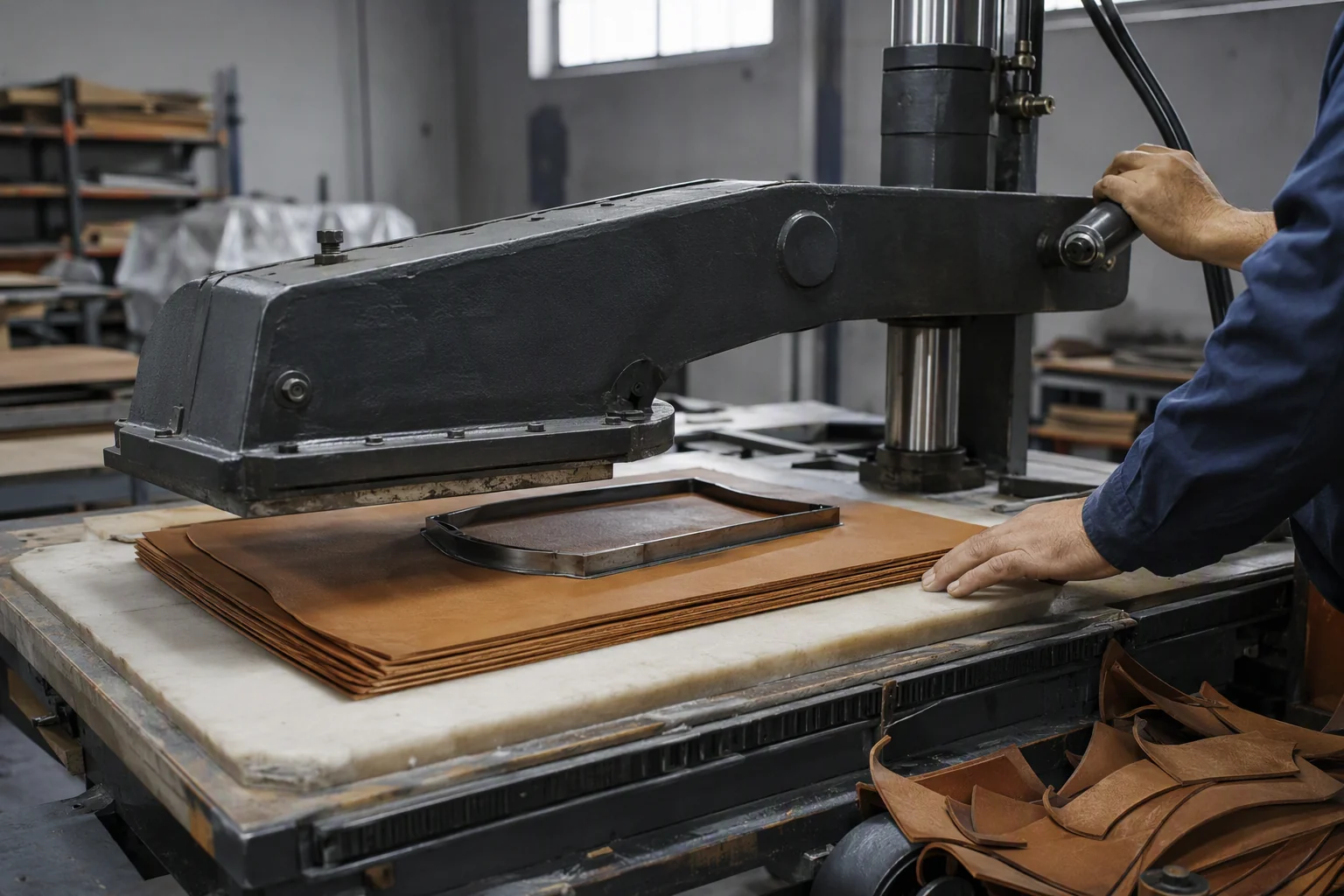
Hydraulic Presses and Duty Cycle
A beam press or a swing-arm press draws heavily while the ram is moving and little while it holds. Its energy profile is therefore spiky, and spiky loads are expensive under demand tariffs. Two presses starting together create a peak that neither would create alone.
Skiving Machines
Skiving removes thickness from leather edges and runs continuously while an operator feeds pieces. Because the motor is small but the machine is often left running between bundles, the idle share is high. Skiving also generates dust, which means extraction runs alongside it.
Dies, Vacuums and Hold-Down
Cutting tables that hold leather by vacuum run a pump for as long as the table is active. The load is steady rather than spiky, which makes it easy to overlook, and it is one of the loads most often found running through breaks.
Compressed Air: The Most Expensive Utility per Unit
Leaks Are a Standing Load
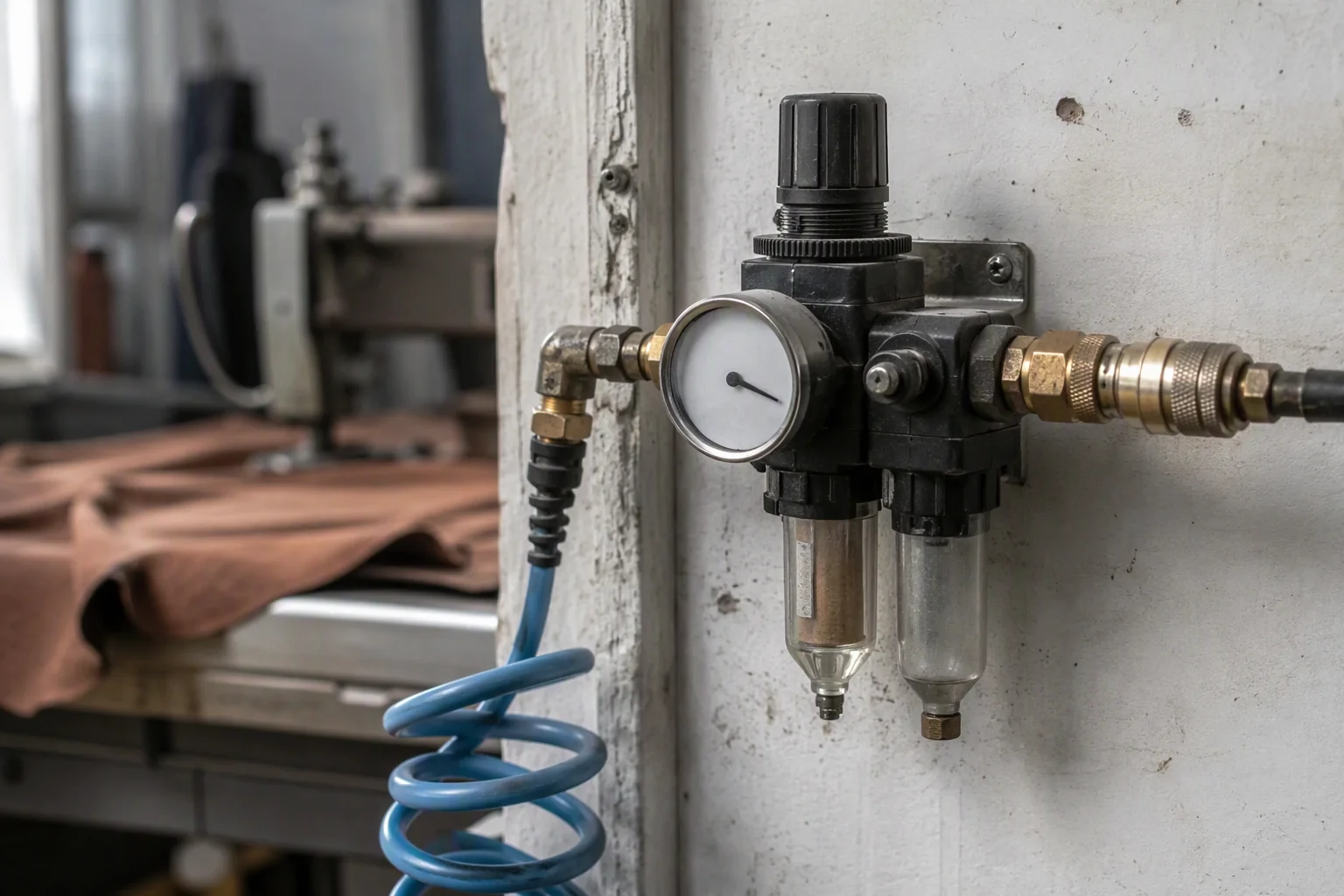
A compressed air system leaks at joints, couplings, hoses and tools, and a plant with many quick-release fittings leaks more than it expects. Leaks cost nothing to find with a listening survey during a quiet period, and the repair list is usually long. This is why compressed air is the first place to look in almost every plant.
Pressure Setpoints
Systems are often run at a higher pressure than any tool requires, because raising pressure is the quickest way to fix an underpowered tool. Every increment of pressure costs energy continuously. Reviewing what each tool actually needs, and whether the system can run lower, is a cheap and durable saving.
Switching Off at the End of Shift
Compressors left running overnight to serve nothing are common. A timer or a clear shutdown routine, with one named person responsible, removes a load that otherwise runs for a third of the day. Where a plant runs two shifts, the gap between them is where the waste concentrates.
Comfort Loads and Leather’s Own Requirements
Why Leather Needs Conditioning
Leather takes up and releases moisture, and its handling behaviour changes with the room. Very dry air makes it stiff and prone to cracking at folds; very humid air encourages mould. Conditioned space is therefore a production requirement, not a comfort perk, and it should be specified as a range rather than a temperature.
Cooling Load From People and Machines
Every sewing motor, every light fitting and every person adds heat. Insulating a roof or shading a window reduces the load before any cooling equipment runs, which is cheaper than buying a larger unit. Plants that upgrade cooling before fixing the envelope pay twice.
Setback Schedules That Do Not Damage Stock
Night setback saves energy only if the space recovers in time and the stored leather tolerates the swing. A schedule written with the production planner, not only the maintenance team, avoids the situation where the plant is cool at the start of the shift but the stock has suffered.
Energy per Bag: The Only Comparable Number
Absolute consumption tells you the size of a plant. Energy per bag tells you how well it is run. The second is the number that survives comparison between factories, between months and between styles.
| Metric | How it is calculated | What it tells you | Weakness |
|---|---|---|---|
| kWh per month | Meter reading | Plant size and trend | Not comparable between plants |
| kWh per bag shipped | Monthly kWh ÷ units shipped | Overall intensity | Mixes styles of different complexity |
| kWh per standard hour | Monthly kWh ÷ production hours | Operational efficiency | Ignores volume changes |
| kWh per square metre | Monthly kWh ÷ floor area | Rough benchmark | Rewards empty space |
| Peak kW per shift | Meter maximum demand | Tariff exposure | Says nothing about total use |
Allocating Fixed Loads
Compressed air, lighting and cooling serve the whole plant, so allocating them to a specific order requires an agreed basis: floor area occupied, machine hours, or labour hours. Whichever basis is chosen must be stated, because different bases produce different numbers for the same order.
Normalising for Style Complexity
A structured tote with heavy skiving and multiple fused panels takes more machine time than a simple pouch, and its energy per unit will be higher without the plant being less efficient. Normalising by standard minutes rather than by pieces keeps the comparison honest.
Reporting a Range, Not a Point
A single figure implies a precision that monthly data does not support. Reporting a range, with the measurement period and the basis of allocation, is both more honest and more durable. It also survives the follow-up question that a point estimate cannot answer.
Peak Demand and How Tariffs Punish Starts
Why a Peak Costs More Than Volume
Demand is charged on the maximum draw within a billing period, so fifteen minutes of simultaneous starting can set the charge for a month of ordinary running. This is why plants that look efficient on consumption can still pay badly, and why the fix is scheduling rather than investment.
Staggering Machine Start-Ups
Simple sequencing, with presses and compressors started in a defined order rather than all at once at the beginning of a shift, reduces the peak without reducing output. It requires a written routine and a supervisor who enforces it for the first few weeks.
Load Shifting Without Stopping Production
Where a plant has flexibility, moving energy-intensive preparation to off-peak periods reduces cost without touching quality. The constraint is that leather processes have their own sequencing, so the shift has to be designed around the material rather than around the tariff alone.
The Cheap Wins, in Order
Most plants can reduce energy noticeably without buying anything. The list below is ordered by return on effort, not by sophistication.
- Leak repair on the compressed air system, repeated quarterly
- Shutdown routines with named responsibility at shift end and breaks
- Idle settings on sewing machines and skivers
- Lighting controls in stores, corridors and low-traffic areas
- Door and curtain discipline between conditioned and unconditioned space
Leak Repair First
It costs labour rather than capital, it can be done during a shutdown, and it produces a permanent reduction in the baseline. No other measure returns as much for as little.
Idle Shutdown Rules
A rule that machines are switched off during breaks is only real if someone checks. Written rules without a check become habits within a month, and the savings quietly disappear.
Lighting Retrofit
Replacing remaining inefficient fittings pays back quickly in plants that run long shifts, and improves the working condition at the same time. It is the least controversial item on any list.
Motor Replacement
Replacing clutch motors with servo drives on the machines that stop most often gives the best return. Replacing every machine at once rarely does, because the machines with long continuous runs gain least.
The Expensive Wins and When They Pay
Rooftop Solar
Solar reduces daytime consumption and hedges against tariff increases, but it produces most when the plant may not need it and nothing at night. Its payback depends on the load profile, the local tariff and the roof, which is why quoted paybacks vary so widely between plants in the same city.
Heat Recovery From Compressors
Most of the energy used to compress air leaves the machine as heat. Where a plant needs hot water or space heating, recovering that heat is a genuine saving rather than an accounting one. Where it does not, the same investment buys nothing.
Replacing Machines
New equipment is the most expensive route to efficiency and the easiest to justify badly. The case should rest on measured duty cycle, not on the rated efficiency on a plate, because most of the savings come from the hours a machine is not doing useful work.
What a Brand Should Ask a Factory
Questions That Produce Numbers
- What is your annual electricity consumption, and over what period was it measured?
- Do you sub-meter any process, and which one?
- How many kilowatt-hours per thousand bags did last year’s production require?
- Has your maximum demand changed in the last two years, and why?
- Which single measure reduced your consumption most?
Questions That Produce Adjectives
Questions about commitment, awareness and culture produce answers that cannot be checked. They are not useless in a relationship, but they cannot support a public claim, and they should not be mistaken for evidence.
Evidence on Site
Meter readings, a tariff copy, a shutdown routine on a wall and a compressor room that is not leaking are all observable in twenty minutes. A site visit that combines a walk through the plant with a look at the meter is worth more than any questionnaire.
Claims, Contracts and Honest Language
What Can Be Claimed
A factory can describe its own measured consumption, its own reduction over a defined period, and the measures it has installed. It cannot claim an emissions outcome for a customer’s product unless the allocation and the method are agreed in advance and documented.
Contractual Instruments
Where a brand wants energy performance written into an agreement, the practical form is a defined metric, a defined boundary, a defined measurement period and a defined consequence. Anything less becomes a discussion at the end of the year.
Language That Survives Scrutiny
Phrases such as “energy-efficient plant” survive nothing. Phrases such as “measured 0.42 kWh per bag over the last four quarters, boundary: cutting, sewing, finishing” survive everything, because they can be checked by someone who disagrees.
Common Measurement Mistakes
Estimating From Floor Area
Floor area is a proxy for size, not for consumption. Two plants of identical area can differ by a factor of two depending on processes, shifts and equipment, so area-based estimates mislead in both directions.
Dividing by Units Shipped Only
Dividing total consumption by pieces rewards simple styles and punishes complex ones. Where a plant makes both, the number moves with the sales mix rather than with efficiency, and decisions based on it go wrong.
Ignoring Subcontracted Operations
Energy used by a subcontractor is outside the plant’s meter but inside the product. A plant that outsources its heaviest process looks efficient and is not, which is why the boundary of any figure must be stated with the figure.
A One-Page Energy Baseline
A baseline that fits on one page gets used. Anything longer gets filed.
- Boundary: which processes and which site
- Period: at least twelve months, stated dates
- Total electricity: consumption and maximum demand
- Fuel or heat: quantity and source
- Top three consumers: from sub-metering or survey
- Energy per bag: value, basis of allocation, and range
- Baseline year: the year against which future change is measured
- Measures installed: with dates and measured effect
- Owner: the person who maintains the record
Seasonal Peaks and How Leather Plants Cope
Summer Loading
Cooling load rises with outside temperature, and in a plant without a shaded roof or insulated walls the cooling equipment fights the building all afternoon. The result is a summer peak that sets the demand charge for months in which nothing unusual happens. Shading and roof treatment reduce the peak before any equipment runs.
Holiday Shutdowns
A plant that closes for a week should also close its compressors, its chillers and its standby equipment. Many do not, because nobody owns the shutdown list. A written procedure, checked once, removes a cost that otherwise repeats every year without appearing in any budget line.
Weather and Drying
Humidity affects how leather dries after finishing and how long conditioned air must run. In a wet season the dehumidification load rises even when production is unchanged, which is why energy per bag can move for reasons that have nothing to do with efficiency.
People, Behaviour and the Limits of Technology
Why Rules Decay
Every plant has a shutdown rule. Most have stopped following it, usually because the rule arrived as an instruction rather than as a routine, and because nothing happened when it was ignored. Rules that survive are short, owned and checked.
Training That Sticks
Training that explains why a compressor runs overnight is remembered longer than a poster asking for it to be switched off. Operators who understand what a leak costs tend to report leaks, and a plant that receives reports has a maintenance list it did not have before.
Incentives That Do Not Backfire
Schemes that reward reduced consumption without a quality check invite shortcuts in drying, fusing or conditioning. Where an incentive exists, it should be paired with a quality measure, so that saving energy cannot be achieved by damaging goods.
A saving that appears in the meter and disappears in the rework column is not a saving. Measure both, or do not claim either.
Working With the Utility and the Landlord
Tariff Reviews
Tariffs change, and a plant on an unsuitable tariff can pay more than a plant that uses more energy on a better structure. An annual review with the utility, comparing the actual load profile against the available options, is routine in well-run factories and rare elsewhere.
Metering Access
Sub-metering requires access to distribution boards and permission to install equipment. Where the building is leased, that permission belongs to the landlord, and asking late delays the work by months. Asking early is the difference between a project and a proposal.
Tenanted Buildings
In a shared building, the meter may cover several tenants and the apportionment may be by floor area. A factory in that position cannot compute energy per bag honestly until the apportionment is documented, and should say so rather than quoting a figure it cannot defend.
If the boundary of a number is unclear, the number is not a measurement. It is an opinion with units attached.
How Energy Shows Up in Price and Lead Time
The Cost Pass-Through
Energy is a small share of a leather bag’s cost compared with material and labour, which is why it rarely drives price on its own. It becomes visible when a plant is asked to absorb a tariff increase, or when a customer asks for a change that adds heat-intensive processing.
Capacity Constraints
Where a plant is limited by electrical capacity rather than by floor space, additional machines may require an upgrade that costs more than the machines. This is a real constraint in older buildings and a question worth asking before a large order is placed.
Frequently Asked Questions
Is compressed air really the largest energy consumer in a bag factory?
In many plants it is, or close to it, because leaks and continuous running add up across the whole day. It is not universal. A plant with a well-maintained system and disciplined shutdown may find cooling or sewing machines larger. The only way to know is to meter.
How accurate does a first energy measurement need to be?
Accurate enough to rank consumers correctly. A clamp logger on the main feed plus a week of spot readings on major machines achieves that. Precision to a decimal point is unnecessary for the first decision and often delays it indefinitely.
Do servo motors on sewing machines justify replacement?
On machines that stop frequently, yes, because the saving comes from the stopped time rather than from the running time. On machines that run continuously for long stretches, the gain is smaller and the payback longer.
Why does my factory’s bill rise when production falls?
Because part of the bill is fixed: standing loads, demand charges and minimum consumption. A plant running at half volume still runs its compressor, its lighting and its cooling. This is also why energy per bag rises sharply when volume drops.
Can a factory claim a product is made with renewable electricity?
Only where the electricity supply and the contractual instrument support that claim, and only for the boundary and period defined. A rooftop array on the factory roof does not by itself make every bag renewable, because it supplies part of the load at certain hours.
What is a reasonable energy figure to ask a supplier for?
Kilowatt-hours per thousand bags over a stated twelve-month period, with the processes included in the boundary. A single plant-level number without a boundary cannot be compared with anything.
Does humidity control cost much energy?
It can, particularly in hot humid climates where dehumidification runs alongside cooling. The cost is usually justified by leather quality, since dry air damages leather at folds and humid air risks mould. The saving lies in the envelope, not in relaxing the range.
Are demand charges avoidable?
Not avoidable, but manageable. Staggering start-ups, sequencing compressors and avoiding simultaneous heavy draws lower the maximum. The charge is set by the peak, so the peak is the thing to control.
How often should a leak survey be repeated?
Quarterly is a practical rhythm in plants with many fittings, and at least twice a year elsewhere. Leaks recur as hoses are moved and couplings wear, so a single survey is a moment rather than a result.
Does energy efficiency change the quality of the bag?
It should not, and where it does the measure is wrong. Reducing leakage, stopping idle machines and controlling lighting affect the plant, not the product. Anything that changes drying, fusing or conditioning times has to be validated on the goods.
What is the simplest first step for a factory that has never measured?
Read the meter daily for a month, at the same time each day, and note production hours alongside. The pattern that emerges usually identifies the standing load, and the standing load is where the first saving is.
Conclusion
Energy in a leather bag factory is concentrated in places that are easy to overlook: a leaking air line, a compressor running through the night, a press starting at the same moment as its neighbour. None of these appear on an organisation chart, and none of them are visible in a photograph of a busy sewing floor. They are visible in a meter reading taken at the right time.
For a brand, the practical implication is narrow and useful. Ask for a number with a boundary and a period, ask which processes were metered, and ask what changed as a result. A factory that can answer those three questions is measuring; a factory that answers with adjectives is not.
The difference matters less for the environment than for the reliability of everything else the factory says about itself. A plant that knows where its energy goes usually knows where its other costs go too, and the habit of measuring is what connects the two.
